Ember & Chair Steakhouse seating · Foshan, China WhatsApp
Send the floor plan and the seat count. Layout and quote back in two working days. Talk to us →
Steakhouse furniture Ember & ChairSteakhouse seating 829 models Design
Home/Three hides in stock, and any other cover to your sample.

Three hides in stock, and any other cover to your sample.

What each cover is, what it survives and how it is cleaned. The three below sit on the shelf. Fabric you send is cut on the same frame, so the cover stays a decision you can change after the layout is signed.

Cover
1.2 mm PU leather · 1.4 mm saddle · 1.6 mm veg tanned · fabric to sample
Foam
40 kg/m³ and 45 kg/m³, two-layer on seats
Powder
RAL and NCS, four-stage pre-treatment
Timber
Kiln-dried European ash as standard, solid oak and walnut on request
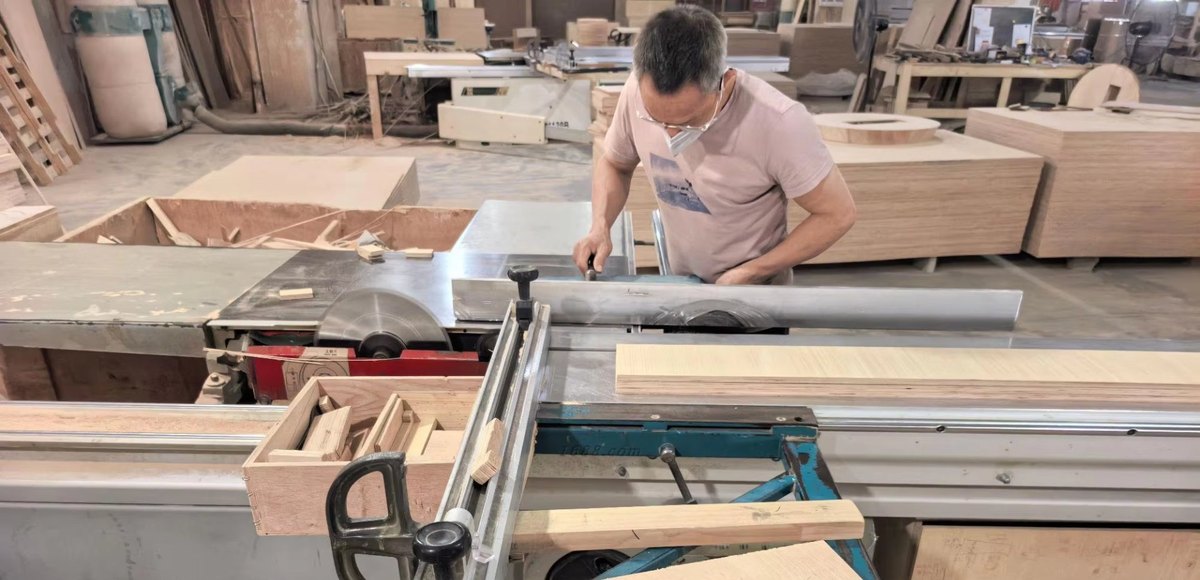
Carpenter guiding a board past the blade of a sliding table saw in the workshop

PU leather

1.2 mm

Wipe-clean and uniform, and the least expensive way to put a dark cover on a seat. It handles fat and salt better than most fabrics do. The coating flexes at the front lip, and that is where a PU seat shows wear first.

Best on
The back row, the waiting bench, and any cover replaced on a schedule.
Watch
The seat a regular takes every week, if three years is the target.

Saddle hide

1.4 mm

The working grade for a dining area. Tanned for abrasion, waxed and sealed, so it takes a stain instead of showing a scuff. Full grain means the original surface of the skin is kept.

Best on
The dining area, including the seat a regular takes every week.
Watch
Damp cloth and a neutral cleaner. Conditioner every quarter at the fold where the back meets the seat, because drying starts there and a repair can never be hidden.

Vegetable tanned hide

1.6 mm

Thicker, open pore, and it changes colour where hands land. In a steakhouse with low light that is the point. In one with a hot pass and no extraction it becomes a liability.

Best on
Booth backs that are touched and not sat on, in low light.
Watch
Oiled rather than sealed, so it needs feeding twice a year.

Foam, and where the dip comes from

40 kg/m³ under a stool pad, 45 kg/m³ on a booth. Anything that takes a two-hour sitting gets two layers: a softer top for the seat, a firmer base so the frame underneath cannot be felt.

Foam over a webbed frame loses 15 mm in a year at the sit bones. Foam over an 18 mm plywood deck does not, and that is what the deck is for.

Powder coat, and the weld underneath

Four-stage pre-treatment runs first: degrease, rinse, phosphate, dry. Then powder. Skip the phosphate and the coat fails at the weld seam first, because that is where the surface is least uniform.

RAL and NCS are both available. Powder matches a wall paint closer than hide does, so decide which of the two carries the colour before the design locks.

The cover we did not list

Cut from your sample

Most of what leaves the shop is hide or PU leather, because a steakhouse wipes a seat far more often than it washes one. Contract fabric is the third option and it is a real one. Send the sample, and the seat is cut from it and photographed under the light of your steakhouse before the batch runs.

The frame does not change. Chairs, booths and stools all take hide, PU leather or fabric over the same deck, so the cover stays a decision you can make after the layout is signed.

Questions

Can covers be replaced later without new frames?

Yes on every model. Seat pads and booth cushions come off on screws, and the covers are cut from the same pattern five years later. The frame is the part we expect to outlive two covers.

Do you send a physical swatch?

Yes, a card with the hides, the fabrics, the powders and the foams, by courier before an order. Screens cannot show a dark brown reliably, and this range is almost entirely dark browns.

Spec sheet

The nine numbers, and the tolerance behind them.

Open

Weight rating

Furniture weight capacity is usually quoted at 150 kg static, which describes a load applied once to a new piece.

Open

Welding

Furniture welding is usually MIG at 3 to 4 mm fillet, and the failure point is the toe instead of the throat.

Open

Frame joints

Mortise-and-tenon joints cut 60 mm deep hold a 150 kg static load without a corner block.

Open

Leg clearance

Table leg clearance runs from the underside of the apron at 620 to 650 mm to the floor.

Open

Communal tables

Communal table tops run to about 3,000 mm in one piece before handling and movement force a joint.

Open

Send the floor plan. Get the layout and the quote.

Dimensions, seat count and the finish you have in mind are enough to start. What comes back is a quantity per line, a leather card, a sample date and a loading window. All of it fits on one page.

Own workshop · EXW Foshan or DDP

Design referencesFourteen positions, measured→ Buying guidesEight decisions, with the numbers→ BlogThree hundred notes, two a day→ Project filesThree projects, and what changed→ The spec sheetNine numbers and the tolerance→ Talk about your steakhouseSend the plan, get a seat count→